
Myopia Control & Management
Myopia, or nearsightedness, is a problem with the eye’s shape that affects your ability to focus on faraway things. Without proper treatment, your child’s myopia can significantly worsen over time. Myopia therapy is a relatively new form of treatment, but it’s proved to be effective in slowing the progress of myopia in children1 — mitigating the harm it can cause and improving their vision and quality of life.
What is Myopia?
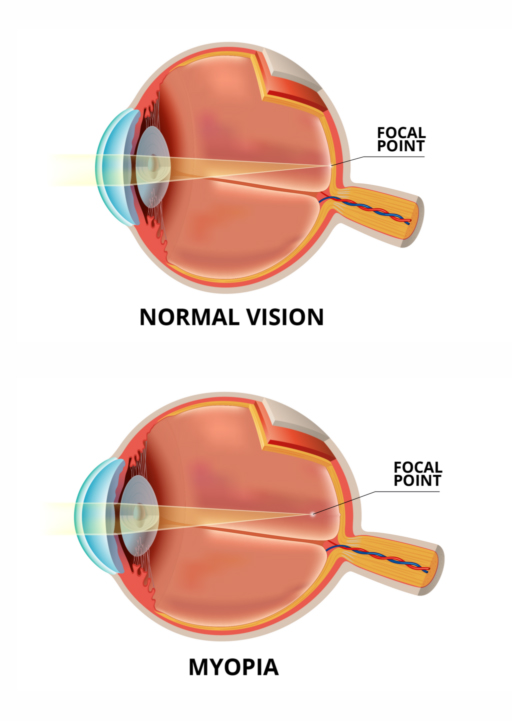
Myopia, commonly known as nearsightedness, is a condition where distance vision appears blurry while near objects remain clear. Myopia occurs when the eye grows too long, causing light to focus in front of the retina rather than directly on it.2 While glasses and contact lenses can correct blurry vision, they do not address the underlying progression of myopia.
Myopia has become increasingly common among children worldwide. Myopia is projected to affect roughly half of the world’s population by 2050.3 Complications associated with myopia progression include retinal detachment, glaucoma, myopic macular degeneration, and early onset cataracts.4, 5, 6 For this reason, managing myopia progression during childhood has become a critical part of preserving long-term eye health.
What is Myopia Management?
Myopia management refers to specialized treatment strategies designed to slow the progression of nearsightedness in growing children. Rather than simply updating a child’s prescription each year, myopia management focuses on reducing the rate at which the eye continues to elongate, and the prescription continues to increase.7, 8
At our practice, we take a proactive approach to myopia control by utilizing advanced technology, evidence-based treatments, and ongoing monitoring to help protect your child’s vision for the future.
A key component of successful myopia management is measuring axial length, which is the length of the eye from front to back.9 Our office utilizes axial length measurements to accurately monitor eye growth over time and evaluate how effective the treatment is to track your child’s progress with greater precision rather than prescription changes alone.
Which Children Should Be Evaluated?
Myopia management is most valuable for children whose nearsightedness begins early or is increasing quickly. The younger a child is when myopia starts, the more it tends to progress and the higher the long-term risk. 10, 11 Family history matters too. A child with one or both nearsighted parents is more likely to become myopic.12 We recommend a baseline evaluation for any child showing early signs of nearsightedness, or who has a nearsighted parent, ideally before the prescription starts to climb.
Myopia Management Treatment Options
Every child is unique, and the best treatment option depends on age, prescription, lifestyle, and rate of progression. We offer several proven treatment options, including:

Essilor® Stellest® Lenses
Essilor® Stellest® lenses are spectacle lenses which are FDA-authorized to provide clear vision with the ultimate goal to slow myopia progression.13, 14
These lenses are designed to provide clear vision while incorporating optical elements in the periphery of the lens to help slow down myopia progression in children ages 6-12. These lenses have been shown to slow the progression by almost 70% in children who wear them consistently, about 12 hours a day1 2.

Multifocal Soft Contact Lenses
The design provides clear vision while creating a peripheral defocus to the retina to potentially slow down myopia progression.15
Multifocal soft contact lenses is worn during the day. The design provides clear vision while creating a peripheral defocus to the retina to slow down myopia progression. We use the most effective lenses to slow the progression of your child’s myopia. We are proud to have been a center for a clinical trial to test one of these contact modalities.

Low-Dose Atropine (LDA)
A prescription eye drop used nightly to help slow the progression of myopia.16
The clinical evidence suggests its ability to control myopia is related to concentration. The stronger the eye drops the more effective. The downside is that symptoms of near vision blur and sensitivity light increase with concentration. Therefore, we use the measurements of axial length that are sensitive to growth over 3 months to determine the proper concentration.

Orthokeratology (Ortho-k)
A rigid contact lens is worn while sleeping to gently reshape the front surface of the eye to allow clear vision during the day without glasses or contact lenses.17
In addition to correcting the vision in the daytime, it has also been shown to effectively slow down myopia progression by around 45-50%. Because these lenses are worn overnight, lens hygiene and regular follow-up matter. The risk of a corneal infection is low, but not zero, so we monitor lens care and eye health closely.
What Families Can Do at Home
Clinical treatment works best alongside healthy visual habits. Spending more time outdoors, roughly an extra hour or two a day is consistently associated with a lower chance of a child becoming nearsighted.18, 19 Regular breaks from close-up work (reading, tablets, phones) are sensible for the whole family.20 Time outdoors mainly helps delay nearsightedness from starting and is not a substitute for treatment once a child is already myopic, so we recommend it as a complement to, not a replacement for our myopia management treatment plans.21
After a thorough examination, we will determine the best treatment option for you. Successful therapy occurs when progression slows by 50%. For further information, please view our publications listed below or schedule an appointment with our office today!

Is Myopia Management Right for Your Child?
Schedule a consultation with our team to review your child’s vision, eye health, prescription, and determine whether myopia management may be right for them. We’ll help you understand the available options and develop a plan tailored to your child’s needs.
- American Association for Pediatric Ophthalmology and Strabismus. Myopia and treatment of myopia in children. AAPOS Eye Terms & Conditions Glossary. Updated August 25, 2026. Accessed October 28, 2026. https://aapos.org/glossary/myopia-and-treatment-of-myopia-in-children
- Ostrow GI, Kirkeby L. Myopia. EyeWiki. Updated July 21, 2026. Accessed October 28, 2026. https://eyewiki.org/Myopia
- Holden BA, Fricke TR, Wilson DA, et al. Global prevalence of myopia and high myopia and temporal trends from 2000 through 2050. Ophthalmology. 2016;123(5):1036-1042. doi:10.1016/j.ophtha.2016.01.006
- Qiu M, Wang SY, Singh K, Lin SC. Association between myopia and glaucoma in the United States population. Invest Ophthalmol Vis Sci. 2013;54(1):830-835. doi:10.1167/iovs.12-11158
- Younan C, Mitchell P, Cumming RG, Rochtchina E, Wang JJ. Myopia and incident cataract and cataract surgery: the Blue Mountains Eye Study. Invest Ophthalmol Vis Sci. 2002;43(12):3625-3632.
- The Eye Disease Case-Control Study Group. Risk factors for idiopathic rhegmatogenous retinal detachment. Am J Epidemiol. 1993;137(7):749-757. doi:10.1093/oxfordjournals.aje.a116736
- Vagge A, Baldi M, Musolino M, Rivarone V, Catti C, Iester M. Current and Emerging Strategies for Myopia Control in Children: A Comprehensive Evidence-Based Review. Journal of Clinical Medicine. 2026; 15(4):1545. https://doi.org/10.3390/jcm15041545
- Kelley S. Myopia control strategies: a parent’s primer on what the evidence shows. All About Vision. Published May 5, 2026. Reviewed March 6, 2026. Accessed October 28, 2026. https://www.allaboutvision.com/conditions/myopia/parents-primer-on-myopia-control-strategies/
- Vagge A, Baldi M, Musolino M, Rivarone V, Catti C, Iester M. Current and Emerging Strategies for Myopia Control in Children: A Comprehensive Evidence-Based Review. Journal of Clinical Medicine. 2026; 15(4):1545. https://doi.org/10.3390/jcm15041545
- Mao C, Zhang X, Liao M, et al. Recalled age of myopia onset may predict risk of high adult myopia in Chinese adults. Ophthalmic Res. 2024;67(1):266-274. doi:10.1159/000538442
- Polling JR, Klaver C, Tideman JW. Myopia progression from wearing first glasses to adult age: the DREAM Study. Br J Ophthalmol. 2022;106(6):820-824. doi:10.1136/bjophthalmol-2020-316234
- Ying ZQ, Li DL, Zheng XY, Zhang XF, Pan CW. Risk factors for myopia among children and adolescents: an umbrella review of published meta-analyses and systematic reviews. Br J Ophthalmol. 2024;108(2):167-174. doi:10.1136/bjo-2022-322773
- Compared to single vision lenses. Results from a prospective, randomized, doublemasked, multicenter U.S. clinical trial in myopic children aged 6–12 years at initiation of treatment.
- Essilor International, data on file (2025)
- Chamberlain P, Bradley A, Arumugam B, et al. Long-term effect of dual-focus contact lenses on myopia progression in children: a 6-year multicenter clinical trial. Optom Vis Sci. 2022;99(3):204-212. doi:10.1097/OPX.0000000000001873
- Zadnik K, Schulman E, Flitcroft I, et al. Efficacy and safety of 0.01% and 0.02% atropine for the treatment of pediatric myopia progression over 3 years: a randomized clinical trial. JAMA Ophthalmol. 2023;141(10):990-999. doi:10.1001/jamaophthalmol.2023.2097
- Sartor L, Hunter DS, Vo ML, Samarawickrama C. Benefits and risks of orthokeratology treatment: a systematic review and meta-analysis. Int Ophthalmol. 2024;44(1):239. doi:10.1007/s10792-024-03175-w
- Kido A, Miyake M, Watanabe N. Interventions to increase time spent outdoors for preventing incidence and progression of myopia in children. Cochrane Database Syst Rev. 2024;6(6):CD013549. doi:10.1002/14651858.CD013549.pub2
- Li D, Min S, Li X. Is spending more time outdoors able to prevent and control myopia in children and adolescents? A meta-analysis. Ophthalmic Res. 2024;67(1):393-404. doi:10.1159/000539229
- Gajjar S, Ostrin LA. A systematic review of near work and myopia: measurement, relationships, mechanisms and clinical corollaries. Acta Ophthalmol. 2022;100(4):376-387. doi:10.1111/aos.15043
- Karthikeyan SK, Ashwini DL, Priyanka M, Nayak A, Biswas S. Physical activity, time spent outdoors, and near work in relation to myopia prevalence, incidence, and progression: an overview of systematic reviews and meta-analyses. Indian J Ophthalmol. 2022;70(3):728-739. doi:10.4103/ijo.IJO_1564_21